The Contagion of Good: Building Environments That Encourage Flourishing
In 1969, psychologist Philip Zimbardo ran a simple experiment on human behavior. He left two identical cars in different neighborhoods, one in the Bronx, one in Palo Alto. Within days, the car in the Bronx was vandalized. The one in Palo Alto remained untouched until Zimbardo himself broke a window. Once the disorder was visible, it invited more. The environment didn’t just reflect behavior, it shaped it.
If visible disorder can make harm contagious, what happens when we make care visible? If a broken window can spread decay, can an act of kindness spread healing?
Psychologists call this social proof, our tendency to take cues from what others do. The same mechanism that spreads indifference can also spread compassion. It depends on what the environment rewards. Apps and social platforms, as the environments of modern life, hold that same power. Every interaction, visual cue, and feedback loop teaches people what’s valued. Whether intentional or not, the system becomes a teacher.
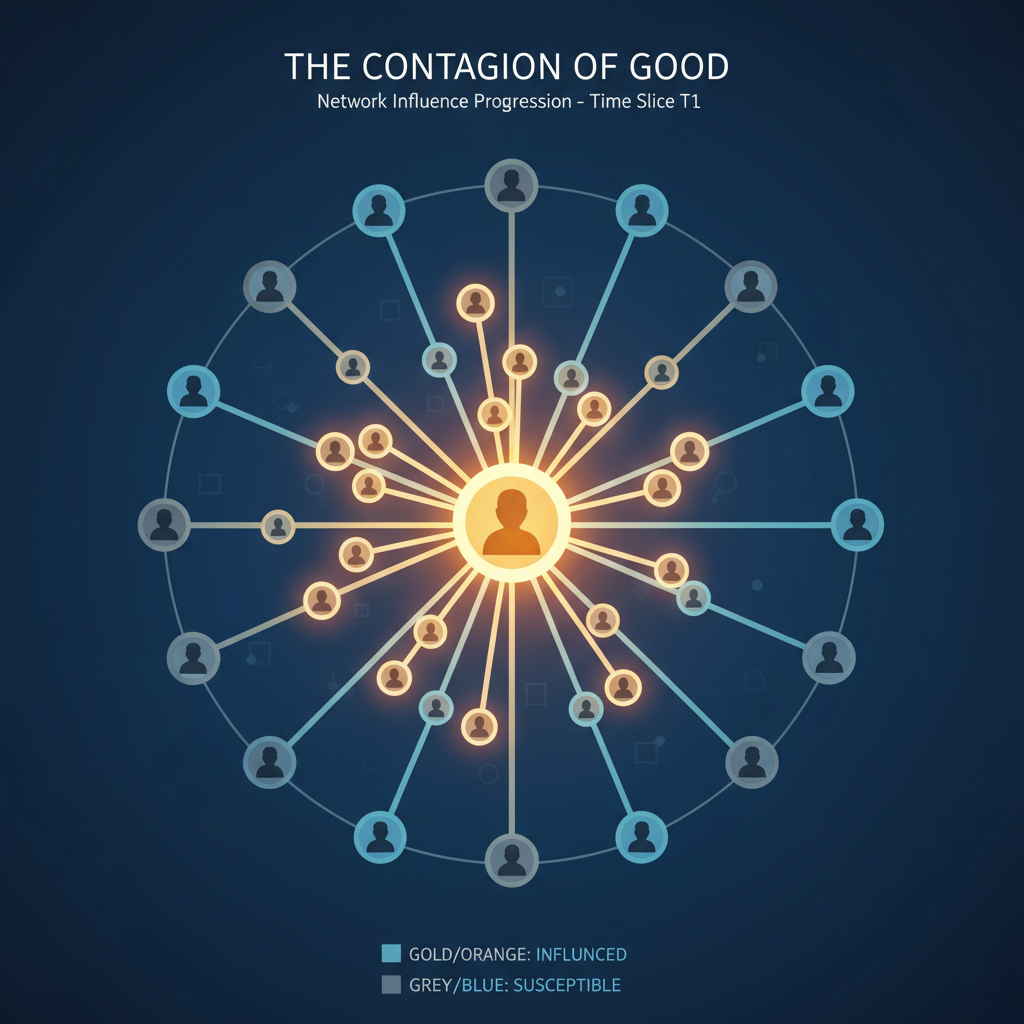
In 2008, researchers Nicholas Christakis and James Fowler found that happiness behaves like a social contagion. Studying thousands of people over two decades, they discovered that happiness spreads through social networks up to three degrees of separation. A friend of a friend of a friend who is happy measurably increases your own chance of feeling the same. Well-being, it turns out, is as contagious as neglect.
Every environment we build, digital or physical, communicates a set of expectations. When we highlight outrage, we amplify it. When we surface kindness, we normalize it. Flourishing follows visibility. What we see becomes what we model. What we model becomes what others learn to repeat.
In behavioral system design, these positive feedback loops form what I call ripple metrics: a way of understanding how good behavior moves through networks. Every encouraging word, every small act of generosity, creates a signal others respond to. When those signals are visible, they compound. Ripple metrics offer a new way to measure progress, not by how long someone stays on a screen, but by how deeply their presence improves the community around them.
When apps and systems begin to reinforce care the way social platforms once reinforced attention, flourishing shifts from an individual goal to a collective experience. It becomes a cultural norm, something we expect, practice, and pass on. The measure of success isn’t how many people engage with a product, but how many lives it quietly improves.
The next generation deserves systems that model the world we hope they’ll inherit, ones that reward compassion, not competition, and promote reflection instead of reaction. Flourishing is generational. It’s the compounding of good choices, well-built systems, and visible care. The next generation is depending on us. How will you build for the future? Let human flourishing be your framework, and ripple metrics be your ruler.
Zimbardo (1969): https://psycnet.apa.org/record/1971-08069-001
Christakis & Fowler (2008): https://www.bmj.com/content/337/bmj.a2338