Keeping AI Agents Grounded: The Role of Ontologies in Agentic Systems
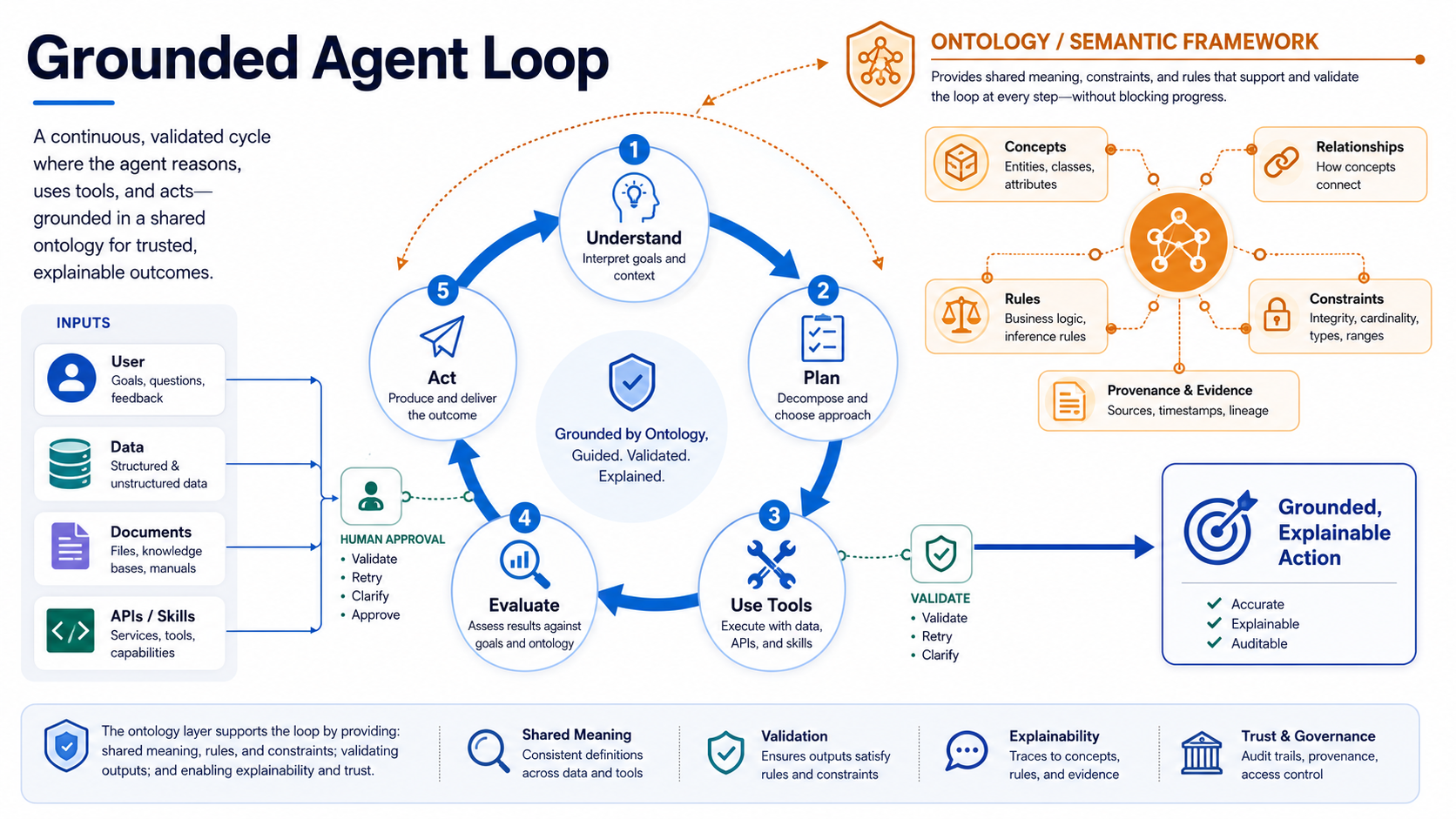
Agentic AI is changing the way software works.
Instead of waiting for a user to issue a precise command, an AI agent can interpret an objective, assemble context, select tools, perform a sequence of actions, evaluate the results, and continue until it reaches an outcome.
This creates a system that’s far more capable than traditional chatbots. An agent can search data, call APIs, update records, generate plans, coordinate other agents, and take actions on a user’s behalf.
It also introduces a new challenge.
Large language models are probabilistic. They are highly effective at understanding language, recognizing patterns, and adapting to ambiguous situations, but they do not inherently operate from a fixed model of what is true, what relationships are valid, or what actions are appropriate within a particular domain.
Prompts and guidelines can influence an agent’s behavior, but instructions written in natural language are still interpreted by the model. As agents gain access to more tools and are trusted with more consequential actions, systems need an additional layer that can verify whether an agent’s conclusions and proposed actions actually make sense.
This is where ontologies can play an important role.
What Is an Ontology?
An ontology is a structured representation of the concepts within a domain and the relationships and rules that connect them.
In simple terms, it gives a system a shared model of how the world is organized.
For an e-commerce system, an ontology might define concepts such as:
Customer
Order
Product
Payment
Refund
Shipment
Support representative
It can also define relationships:
A customer places an order.
An order contains one or more products.
A payment belongs to an order.
A refund is issued against a payment.
A shipment fulfills an order.
The ontology can then add constraints and logical rules:
A refund must reference a valid payment.
A refunded amount cannot exceed the amount paid.
A shipment status must be one of a defined set of values.
A support representative and a customer are different types of entities.
A completed refund should not be issued a second time without additional review.
These rules provide something an LLM does not naturally possess: an explicit and machine-readable model of what is valid within the domain.
The Difference Between Guidelines and Ontologies
Most agentic systems already use guidelines.
A system prompt may tell an agent to protect user privacy, confirm important actions, avoid making unsupported claims, or use a particular tool when specific information is needed.
These guidelines remain essential. They describe how the agent should behave and communicate.
An ontology serves a different purpose.
Guidelines tell the agent:
“Do not issue duplicate refunds.”
The ontology and associated validation rules can determine:
“This order already has a completed refund for the full amount, so the proposed action is invalid.”
Guidelines influence behavior. Ontologies make domain meaning and constraints explicit.
The two work best together:
Guidelines shape the agent’s behavior.
Tool schemas verify that requests are technically valid.
Ontologies verify that information and actions make sense within the domain.
Policies determine whether an action is authorized.
Human approval can be requested when judgment is still required.
Why Agent Loops Need Validation
Most agents operate through some version of a loop:
Interpret the user’s objective.
Decide what information or action is needed.
Select a tool.
Generate the tool parameters.
Execute the tool.
Interpret the result.
Decide what to do next.
Continue until the task is complete.
This loop is what gives agents their power.
It is also where problems can compound.
An agent may misinterpret a tool result, use the wrong entity, repeat an action, drift away from the original objective, or continue operating from an incorrect assumption.
Because each step becomes context for the next step, a small mistake early in the loop can lead to a larger mistake later.
An ontology-aware validator can sit alongside the loop and evaluate the agent’s proposed conclusions and actions before they are accepted.
The new model flow:
The agent interprets the objective.
The agent selects a skill or tool.
The system validates the tool input.
The tool executes.
The result is mapped to known domain concepts.
The ontology checks whether the result is logically consistent.
Policies determine whether the next action is permitted.
The agent proceeds, retries, asks for clarification, or requests human approval.
This creates a system in which the LLM remains flexible, but important decisions are supported by deterministic checks.
“Schema at the Door, Ontology at the Ledger”
A useful way to understand the architecture is to separate structural validation from semantic validation.
Schema validation
A schema verifies whether the information has the correct format.
For example:
{
  "orderId": "ORD-1042",
  "refundAmount": 75.00,
  "currency": "USD"
}
A schema can confirm that:
orderId is present.
refundAmount is numeric.
currency is a valid string.
Required fields have been provided.
This answers:
“Is the request technically well formed?”
Ontology validation
The ontology evaluates what the request means.
It can confirm that:
The order exists.
The payment belongs to the order.
The currency matches the original payment.
The requested refund does not exceed the available amount.
The order has not already been fully refunded.
The requesting user is connected to the order.
This answers:
“Does the request make sense within the domain?”
Both layers are necessary.
A request can be perfectly formatted and still be logically incorrect.
A Practical Example
Imagine a customer-service agent receives this request:
“Refund my last order.”
The agent retrieves the customer’s recent order, creates a refund request, and prepares to call the payment tool.
Before the action is completed, the system checks:
Does the order belong to this customer?
Was the order paid successfully?
Has a refund already been issued?
Is the amount within the refundable balance?
Is the payment method eligible for an automated refund?
Does the action require confirmation?
Is there an unresolved fraud or support case connected to the order?
The agent may then respond:
“I found your most recent order. It was partially refunded earlier, and $42 remains eligible for refund. Would you like me to refund the remaining amount?”
The ontology has not replaced the agent. It has helped the agent interpret the situation correctly and explain the next step clearly.
Ontologies and RAG
Ontologies are sometimes discussed alongside Retrieval-Augmented Generation, or RAG, but they serve different purposes.
RAG helps the system locate relevant information.
It answers:
“What information should the agent consider?”
An ontology helps the system understand and validate that information.
It answers:
“What does this information represent, how is it related, and what conclusions can it support?”
A mature agentic system may combine several forms of retrieval:
Semantic document search
Structured database queries
Knowledge graph traversal
User or account history
Event and time-series data
Tool-generated results
Conversation memory
The ontology provides a common semantic layer across these sources.
For example, two systems may refer to the same idea using different field names:
customer_id
accountHolder
buyer
userReference
An ontology can map these representations to a shared concept while preserving their specific meanings and sources.
This helps the agent reason across systems without treating every data source as an isolated vocabulary.
Supporting Explainable AI
One of the strongest benefits of ontology-guided agents is explainability.
When an agent produces a recommendation or takes an action, the system can preserve the reasoning path:
Which information was retrieved?
Where did it come from?
Which concepts were involved?
Which relationships connected them?
Which constraints were evaluated?
Which policy authorized the action?
Did the user confirm it?
Was any part of the result inferred rather than directly observed?
This allows the system to produce clearer explanations.
Instead of saying:
“I changed the delivery method because it was better.”
The agent could say:
“The original delivery option is no longer available for this address. I found an eligible replacement with the same delivery date and lower cost. I can apply it after you confirm.”
Explainability becomes part of the architecture rather than something generated after the fact.
Supporting Multiple Agents and Skills
Ontologies become even more valuable as systems expand from a single agent into networks of agents and specialized skills.
One agent may manage scheduling. Another may review documents. Another may handle billing. Another may coordinate external services.
Without a shared semantic model, each agent may interpret concepts differently.
For example:
Does “approved” mean approved by the user, a manager, or an automated policy?
Does “complete” mean a task was attempted or successfully verified?
Is an “account” a user profile, a billing account, or an external service account?
Does “current” mean the latest record, the latest verified record, or the latest user-confirmed record?
An ontology creates shared definitions across agents.
This improves coordination and reduces the risk that one agent will pass information to another using an ambiguous or incompatible interpretation.
Avoiding False Certainty
Ontologies can also help systems express uncertainty more accurately.
Not every relationship should be represented as a fact.
A useful ontology can distinguish among:
Causes
Is associated with
May influence
Was observed alongside
Was inferred from
Was reported by a user
Was confirmed by an external source
Requires verification
Conflicts with another record
These distinctions are important because LLMs often produce fluent explanations that sound more certain than the available evidence supports.
By representing confidence, provenance, and relationship type explicitly, the system can generate responses that better reflect what is actually known.
For example:
“These two events occurred during the same period, but the available information does not establish that one caused the other.”
That is a stronger and more trustworthy result than turning correlation into a confident conclusion.
Where the Ontology Sits in the Architecture
A practical agentic architecture might look like this:
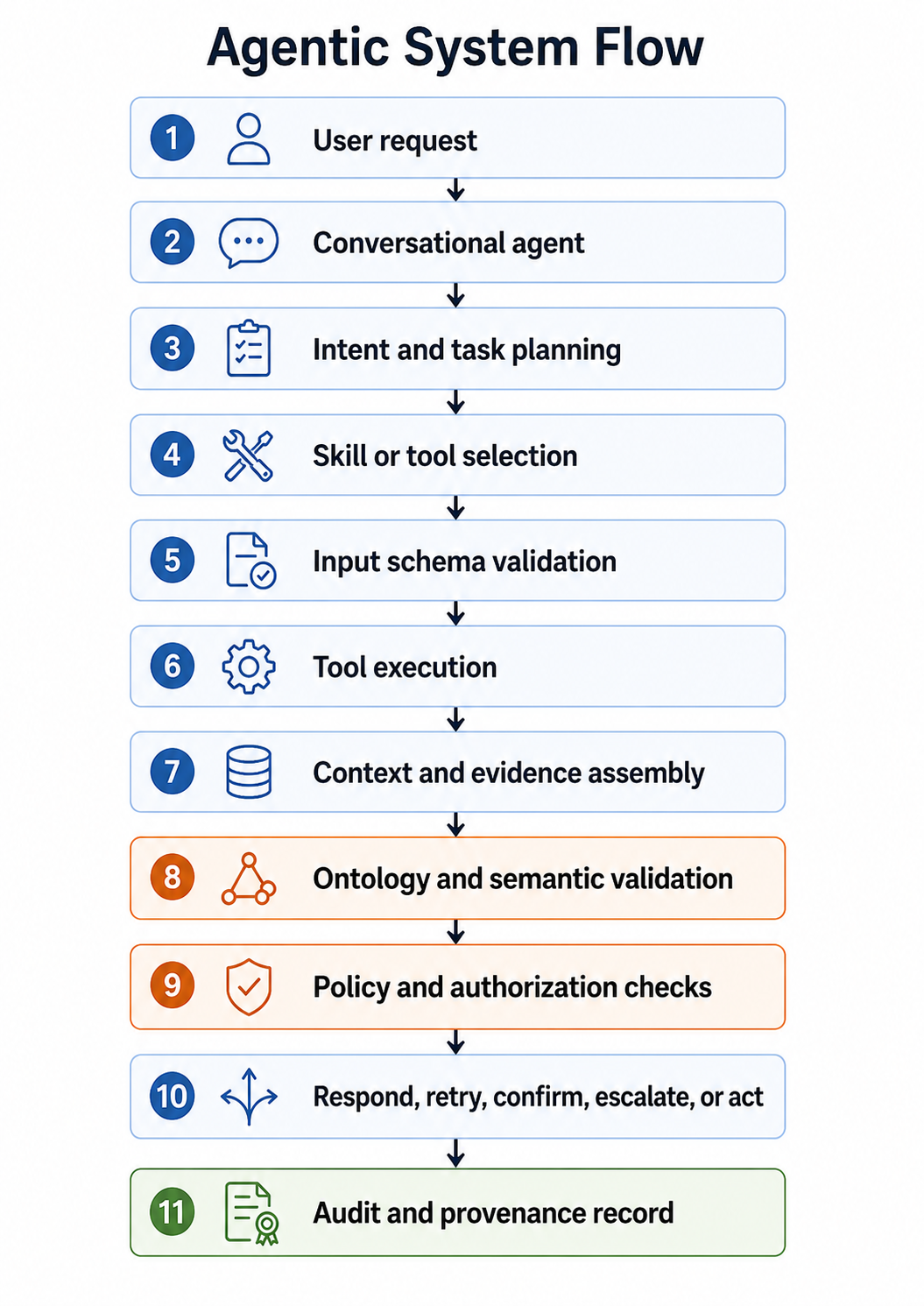
The ontology sits alongside the agent rather than inside the language model.
This distinction matters.
The LLM remains responsible for flexible interpretation, planning, and communication. The ontology and reasoner provide a more stable system for validating meaning, relationships, and constraints.
This combined approach is often referred to as neurosymbolic AI: neural models provide adaptability, while symbolic models provide structure and logical control.
Starting Small
An ontology does not need to model an entire organization before it becomes useful.
A focused implementation can begin with the concepts most closely connected to agent actions.
A practical first phase may include:
Users and organizations
Skills and tools
Resources and records
Ownership and permissions
Actions and action status
Recommendations
Confirmations
Evidence and provenance
Time and validity
Reversible and irreversible operations
The first rules might answer questions such as:
Does this record belong to the current user?
Is this tool result still current?
Has this action already been completed?
Is the proposed action reversible?
Does the action require confirmation?
Does the evidence support the recommendation?
Is the agent authorized to access or change this information?
Do two retrieved records conflict?
From there, the ontology can expand alongside the product.
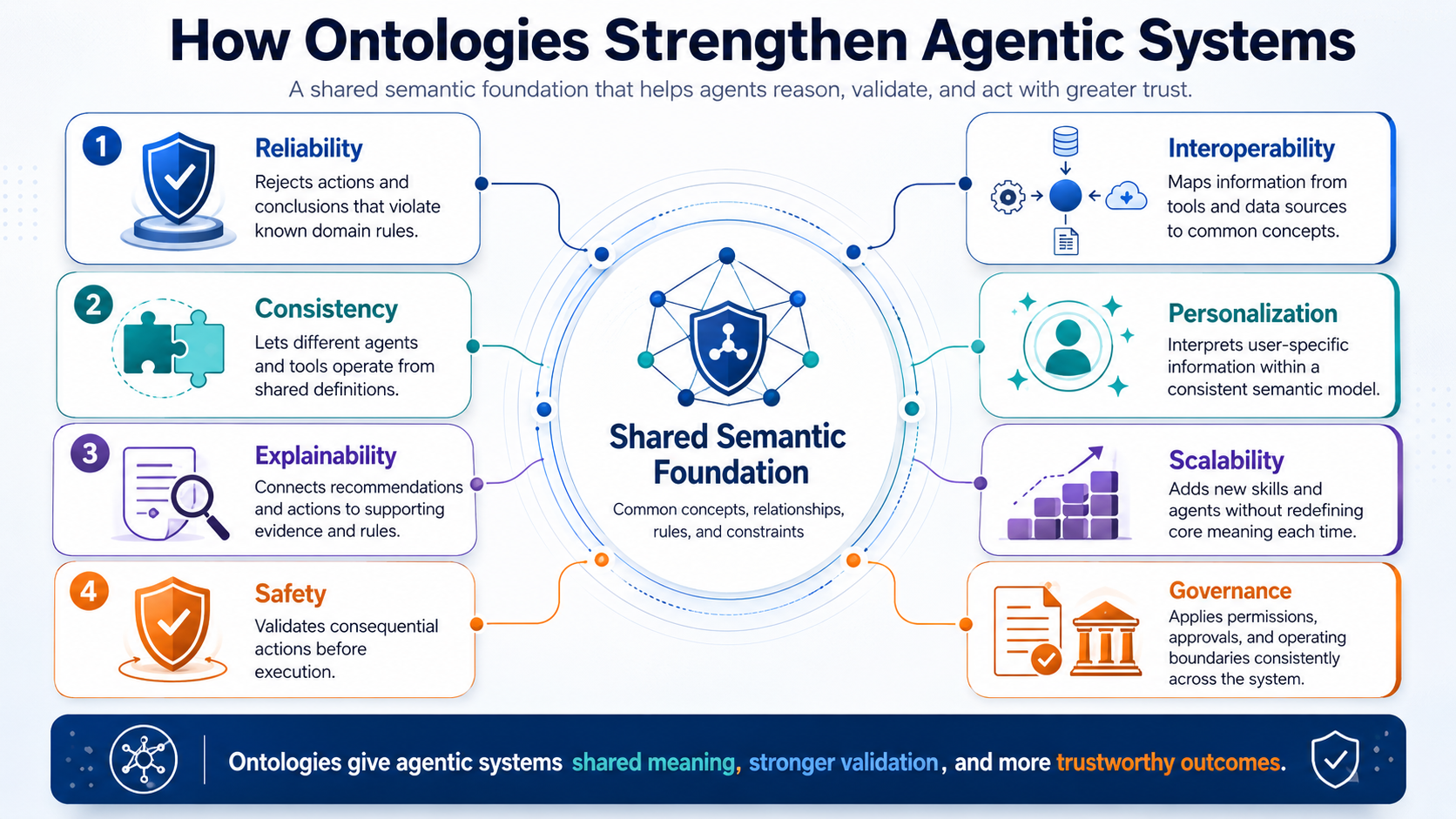
What Ontologies Improve
When integrated thoughtfully, ontologies can improve several aspects of an agentic system:
The Core Idea
Agentic systems need both flexibility and structure.
Large language models provide the flexibility to understand people, interpret ambiguity, generate plans, and adapt to changing situations.
Ontologies provide the structure to define what concepts mean, how they relate, what constraints apply, and whether an agent’s proposed result is logically valid.
Together, they create a stronger model for building agents that are capable without becoming unpredictable.
The goal is not to limit what agents can do. It is to give them a dependable framework within which they can do more.
As agents gain access to more data, tools, and real-world actions, the systems that succeed will be those that combine natural interaction with explicit meaning, verifiable reasoning, and clear operational boundaries.
Ontologies can become the layer that helps keep those agents grounded, consistent, explainable, and worthy of trust.